Zum Inhalt springen
Odoo Menü
  • Anmelden
  • Jetzt gratis testen
  • Apps
    Finanzen
    • Buchhaltung
    • Rechnungsstellung
    • Spesenabrechnung
    • Tabellenkalkulation (BI)
    • Dokumente
    • E-Signatur
    Verkauf
    • CRM
    • Verkauf
    • Kassensystem – Shop
    • Kassensystem – Restaurant
    • Abonnements
    • Vermietung
    Websites
    • Website-Builder
    • E-Commerce
    • Blog
    • Forum
    • Livechat
    • E-Learning
    Lieferkette
    • Lager
    • Fertigung
    • PLM
    • Einkauf
    • Wartung
    • Qualität
    Personalwesen
    • Mitarbeiter
    • Personalbeschaffung
    • Abwesenheiten
    • Mitarbeiterbeurteilung
    • Personalempfehlungen
    • Fuhrpark
    Marketing
    • Social Marketing
    • E-Mail-Marketing
    • SMS-Marketing
    • Veranstaltungen
    • Marketing-Automatisierung
    • Umfragen
    Dienstleistungen
    • Projekte
    • Zeiterfassung
    • Außendienst
    • Kundendienst
    • Planung
    • Termine
    Produktivität
    • Dialog
    • Künstliche Intelligenz
    • IoT
    • VoIP
    • Wissensdatenbank
    • WhatsApp
    Apps von Drittanbietern Odoo Studio Odoo Cloud-Plattform
  • Branchen
    Einzelhandel
    • Buchladen
    • Kleidergeschäft
    • Möbelhaus
    • Lebensmittelgeschäft
    • Baumarkt
    • Spielwarengeschäft
    Essen & Gastgewerbe
    • Bar und Kneipe
    • Restaurant
    • Fast Food
    • Gästehaus
    • Getränkehändler
    • Hotel
    Immobilien
    • Immobilienagentur
    • Architekturbüro
    • Baugewerbe
    • Immobilienverwaltung
    • Gartenarbeit
    • Eigentümervereinigung
    Beratung
    • Buchhaltungsfirma
    • Odoo-Partner
    • Marketingagentur
    • Anwaltskanzlei
    • Talentakquise
    • Prüfung & Zertifizierung
    Fertigung
    • Textil
    • Metall
    • Möbel
    • Speisen
    • Brauerei
    • Firmengeschenke
    Gesundheit & Fitness
    • Sportklub
    • Brillengeschäft
    • Fitnessstudio
    • Therapeut
    • Apotheke
    • Friseursalon
    Handel
    • Handyman
    • IT-Hardware & -Support
    • Solarenergiesysteme
    • Schuster
    • Reinigungsdienstleistungen
    • HLK-Dienstleistungen
    Sonstiges
    • Gemeinnützige Organisation
    • Umweltschutzagentur
    • Plakatwandvermietung
    • Fotostudio
    • Fahrrad-Leasing
    • Software-Händler
    Alle Branchen ansehen
  • Community
    Lernen
    • Tutorials
    • Dokumentation
    • Zertifizierungen
    • Schulung
    • Blog
    • Podcast
    Bildung fördern
    • Bildungsprogramm
    • Scale-Up! Planspiel
    • Odoo besuchen
    Software anfragen
    • Herunterladen
    • Editionen vergleichen
    • Releases
    Zusammenarbeiten
    • Github
    • Forum
    • Veranstaltungen
    • Übersetzungen
    • Partner werden
    • Dienstleistungen für Partner
    • Buchhaltungsfirma registrieren
    Services anfragen
    • Partner finden
    • Buchhalter finden
    • Einen Experten treffen
    • Implementierungsservices
    • Kundenreferenzen
    • Support
    • Upgrades
    Github Youtube Twitter Linkedin Instagram Facebook Spotify
    +1 (650) 691-3277
    Eine Demo erhalten
  • Preise
  • Hilfe
Sie müssen registriert sein, um mit der Community zu interagieren.
Alle Beiträge Personen Abzeichen
Stichwörter (Alle anzeigen)
odoo accounting v14 pos v15
Über dieses Forum
Sie müssen registriert sein, um mit der Community zu interagieren.
Alle Beiträge Personen Abzeichen
Stichwörter (Alle anzeigen)
odoo accounting v14 pos v15
Über dieses Forum
Hilfe

How to Build Custom Forecasted Quantity Reports in Odoo

Abonnieren

Erhalten Sie eine Benachrichtigung, wenn es eine Aktivität zu diesem Beitrag gibt

Diese Frage wurde gekennzeichnet
inventoryreportforecastquickstartQuickstart
2 Antworten
3757 Ansichten
Avatar
Abraham Ismael Torales Salazar (aits)

Use case: 

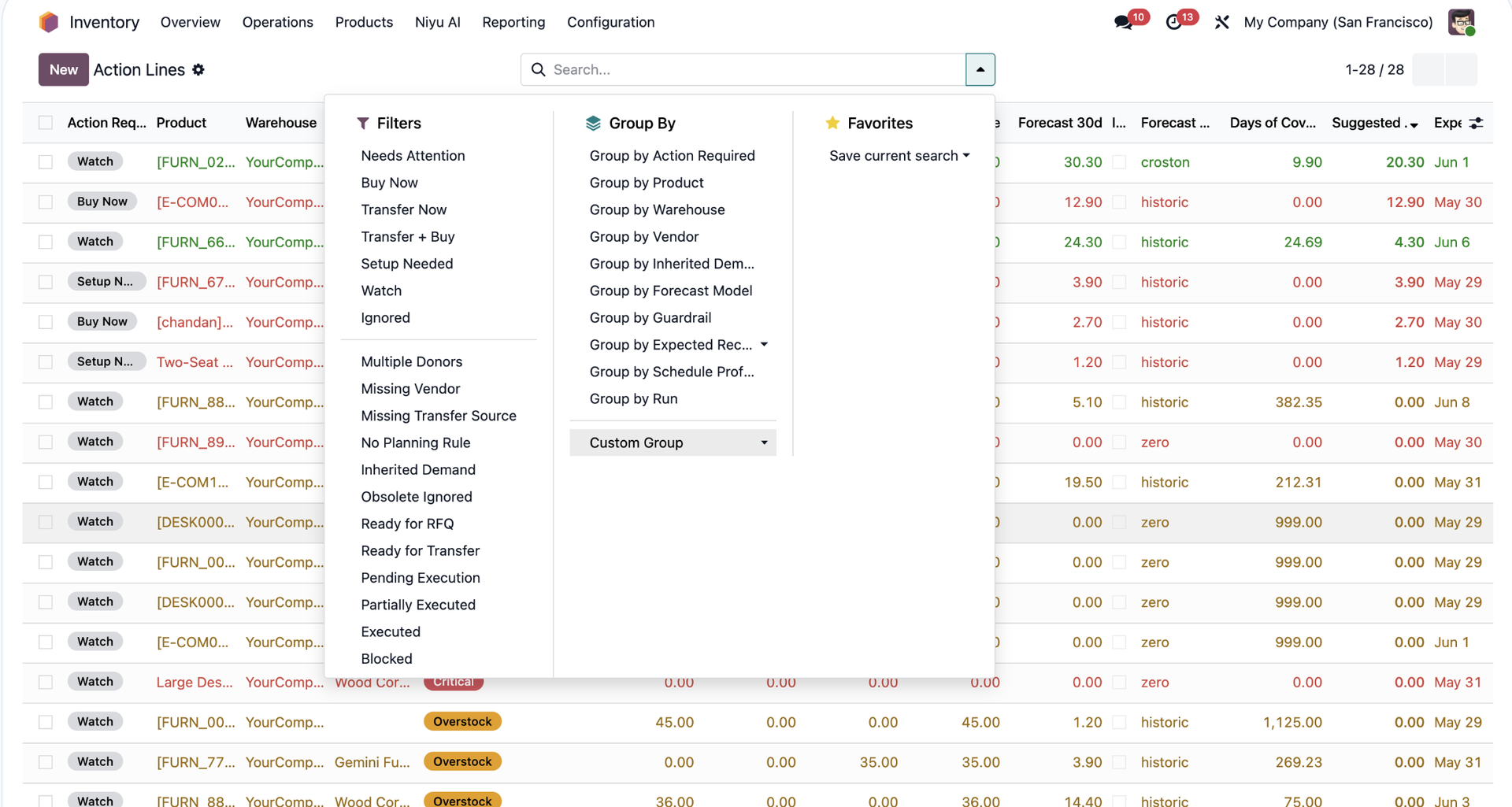
Being able to filter the forecasted inventory quantities by product category, customer, different locations, warehouses etc. or being able to see many products forecasted quantities at once.


Versions: 

This was proven in V18, but the same logic would apply to earlier versions.

2
Avatar
Verwerfen
Avatar
Abraham Ismael Torales Salazar (aits)
Autor Beste Antwort

Option 1


Step 1: Go to Inventory app, open Studio, and add a menu for report.stock.quantity model

Tip: From this page, you could also move the report menu inside any other menu.


Step 2: Inside the new menu page, set the next filter as favorite/default filter

Tip: In case you need it, you can also filter by forecasted receipts or deliveries


Now you can filter/group your report based on different parameters that belong to product template, product variant, date, company and/or warehouse


Example: Report for Product Category Furtniture/Office between September 1 and 30 in the Warehouse "YourCompany"


Tip: Using Studio, you could also add a pivot table view 


Example: Pivot table showing forecasted quantity in products in the category "Furtniture/Office" grouped by month and warehouse


Option 2

Step 1: Add the following models to Spreadhsheets using the action button from the list view

Make sure to add the appropiate filters before inserting the list in Spreadsheet


Models to insert in spreadsheets:

Model

Technical Model Name

Filters

Locations

stock.quant

"Internal Locations"

"In Stock"

Moves Analysis

stock.move

"Incoming"

Status is not in "Done" or "Cancelled"

Moves Analysis

stock.move

"Outgoing"

Status is not in "Done" or "Cancelled"


💡

Make sure to add as many rows (for each table) as you think you will need, depending on the volume of your operations.

​

You can change the name of the sheets and the lists to easier identify each table and manage the Spreadhsheets formulas.


Example:


Step 2: Add a new sheet and manually create a table with the following columns 

  1. Date
  2. All Dates
  3. Pending Incoming
  4. Pending Outgoing
  5. Current Stock
  6. Accumulated Incoming
  7. Accumulated Outgoing
  8. Forecast


Use other 2 cells in the same sheet to stablish the Minimun Date and Maximun Date with the following formulas:


Cell

Formula

Explanation

Min Date

=ROUNDDOWN(

MIN(

FILTER('Incoming quantities'!A:A, 'Incoming quantities'!A:A>0),

FILTER('Outgoing quantities'!A:A, 'Outgoing quantities'!A:A>0), TODAY()

),0

)

Retrieves the minimum date value between the incoming and outgoing quantities table (the Date in both tables is stored in column A) and today.


This formula is ignoring the empty cells by applying the filter > 0, and rounding down to ignore the hours/minutes/seconds


This is based on field "date" in "Moves Analysis" model

Max Date

=ROUNDDOWN(

MAX(

FILTER('Incoming quantities'!A:A, 'Incoming quantities'!A:A>0),

FILTER('Outgoing quantities'!A:A, 'Outgoing quantities'!A:A>0)

),0

) + 10

Retrieves the maximum date value between the incoming and outgoing quantities table (the Date in both tables is stored in column A) and today.


This formula is ignoring the empty cells by applying the filter > 0, and rounding down to ignore the hours/minutes/seconds


The formula is adding 10 days more just to have a better looking graph


This is based on field "date" in "Moves Analysis" model


✅

Remember to format these cells as date

​


💡

If, for any reason, both tables (incoming and outgoing quantities) are empty, it will display value equal to zero, which is equal to Dec 30 1899. We will fix that later.

​

For the table generated in Step 2, add the following formulas and drag them down:


A

B

C

D

E

F

G

H

I

J

K

1

Date

All Dates

Pending Incoming

Pending Outgoing

Current Stock

Accumulated Incoming

Accumulated Outgoing

Forecast


2

=K2

=IF(K2=0,TODAY(),K2)

=SUMIFS('Incoming quantities'!F:F,ROUNDDOWN('Incoming quantities'!A:A),A2)

=SUMIFS('Outgoing quantities'!F:F,ROUNDDOWN('Outgoing quantities'!A:A),A2)

=SUM('Quantities in Stock'!D:D)

=C2

=D2

=IF(A2="","",$E$2+F2-G2)


Minimum Date

(Formula mentioned above)

3

=IF(B3>$K$3,"",B3)

=B2+1

Drag the previous formula down from here

Drag the previous formula down from here

Don't drag formula down

=F2+C3

=G2+D3

Drag the previous formula down from here


Maximum Date

Formula mentioned above)

4

Drag the previous formula down from here

Drag the previous formula down from here


Drag the previous formula down from here

Drag the previous formula down from here


Brief explanation:

  • K2 and K3 in the same sheet are the minimun and maximum dates respectively in my spreadsheet
  • Sheet "Incoming quantities" (list from Move Analysis model):
    • Column A: Dates for each pending receipt in Odoo. Rounding down the dates to ignore the hours/minutes/seconds
      • Field name: "date"
    • Column F: "Demand" quantities for each pending receipt in Odoo
      • Field name: "product_uom_qty"
  • Sheet "Outgoing quantities" (list from Move Analysis model):
    • Column A: Dates for each pending delivery in Odoo. Rounding down the dates to ignore the hours/minutes/seconds
      • Field name: "date"
    • Column F: "Demand" quantities for each pending delivery in Odoo
      • Field name: "product_uom_qty"
  • Sheet "Quantities in Stock" (list from Location Report model):
    • Column D: Inventoried Quantity
      • Field name "inventory_quantity_auto_apply"


Step 3: Add a graph to show the forecast based on date 


Step 4: Add global filters to filter the data you would like to see


Example of filters by location, product categories, and specific product.

Note: For locations, I stablished only one filter as "Intermediate location" for receipts and as "Source location" for deliveries, but you can create two independent filters to have more control over the location filter for receipts and deliveries. You can set one or more locations per filter at the same time, so you can see a report of one or more warehouses


💡

These are "Relation" filters; you can create anyone you want to filter any relational field that exists in the models we linked to the spreadsheets (Locations Report and Move Analysis), you just have to select the field in each table that is linked to the model selected for the filter. 

​

Final result: 


Explanation:

  • I currently have 100 units in my warehouse
  • I will deliver 20 units on Sept 15  Then I will have 80 forecasted units
  • I will receive 10 units on Sep 22  Then I will have 90 forecasted units
  • I will receive 50 units on Oct 01  Then I will have 140 forecasted units


Aditional: Add conditional formating 

In order to identify easier:

  • Today's date in column A and B
  • Any pending recepits/deliveries in column C and D
  • Current Stock in E2
  • The dates when the forecasted quantities are less than or equal to 0


✅

Remember to add as many rows as needed to show all the days between the minimum date and maximum date

​

4
Avatar
Verwerfen
Avatar
Rishu, Niyu Labs
Beste Antwort
Hi,

For this report, the key is to decide whether you need a snapshot report or a live operational report.

A useful forecasted quantity report should usually allow filters by:

- product / product category
- warehouse / location
- customer or demand source
- incoming purchase orders
- outgoing sales/manufacturing demand
- date horizon

The tricky part is that Odoo forecasted quantity is not just one stored number. It depends on stock moves, reservations, incoming receipts, outgoing demand, manufacturing, and the date window. So I would avoid copying only `qty_available` or building a simple product table.

A good first version would be:
- product
- on hand
- outgoing demand
- incoming quantity
- forecasted quantity
- shortage / surplus
- grouped by warehouse and category

We build Odoo inventory planning and reporting workflows at Niyu Labs. If useful, I can share the minimum fields I’d include so the report is operational and not just another spreadsheet.


0
Avatar
Verwerfen
Diskutieren Sie gerne? Treten Sie bei, statt nur zu lesen!

Erstellen Sie heute ein Konto, um exklusive Funktionen zu nutzen und mit unserer tollen Community zu interagieren!

Registrieren
Verknüpfte Beiträge Antworten Ansichten Aktivität
How to use valued delivery notes Gelöst
accounting inventory quickstart Quickstart
Avatar
1
Apr. 26
1132
How to use valued delivery notes
accounting inventory quickstart Quickstart
Avatar
0
Apr. 26
7
How can I get a report on the quantity of products I have sold but not yet reserved? Gelöst
inventory report quantity forecast
Avatar
Avatar
1
Juni 25
2196
¿How can I display the total product quantity from different warehouses in Odoo e-commerce? V 16, 17
inventory ecommerce quickstart Quickstart
Avatar
Avatar
1
Juni 24
5551
Change delivery slip printed from the barcode sheet Gelöst
inventory report quickstart odoo16features
Avatar
1
Sept. 23
3400
Community
  • Tutorials
  • Dokumentation
  • Forum
Open Source
  • Herunterladen
  • Github
  • Runbot
  • Übersetzungen
Dienstleistungen
  • Odoo.sh-Hosting
  • Support
  • Upgrade
  • Individuelle Entwicklungen
  • Bildung
  • Buchhalter finden
  • Partner finden
  • Partner werden
Über uns
  • Unsere Firma
  • Markenwerte
  • Kontakt
  • Karriere
  • Veranstaltungen
  • Podcast
  • Blog
  • Kunden
  • Rechtliches • Datenschutz
  • Sicherheit
الْعَرَبيّة Català 简体中文 繁體中文 (台灣) Čeština Dansk Nederlands English Suomi Français Deutsch हिंदी Bahasa Indonesia Italiano 日本語 한국어 (KR) Lietuvių kalba Język polski Português (BR) română русский язык Slovenský jazyk Slovenščina Español (América Latina) Español Svenska ภาษาไทย Türkçe українська Tiếng Việt

Odoo ist eine Suite von Open-Source-Betriebsanwendungen, die alle Bedürfnisse Ihres Unternehmens abdecken: CRM, E-Commerce, Buchhaltung, Lager, Kassensystem, Projektmanagement etc.

Das einzigartige Wertversprechen von Odoo ist, dass es gleichzeitig sehr einfach zu bedienen und voll integriert ist.

Website made with

Odoo Experience on YouTube

1. Use the live chat to ask your questions.
2. The operator answers within a few minutes.

Live support on Youtube
Watch now