The Calm Before the Compliance Storm
If you are an SME owner or manager in Malaysia, you have likely spent the past two years watching the e-invoicing deadline shift like a finishing line that keeps moving. In December 2025, LHDN confirmed that businesses with annual turnover between RM1 million and RM5 million now have until 2027 to implement mandatory e-invoicing, with the penalty-free transition period extended to a full 12 months.
On the surface, this feels like relief. Another year to breathe. Another year to keep using your current mix of Excel spreadsheets, standalone accounting software, and disconnected sales tools.
But here is the truth that forward-thinking leaders recognise:
The digital economy will not wait for 2027. Your competitors, your suppliers, and increasingly, your customers are already moving toward integrated, real-time business operations. The postponement is not a pause button, it is a strategic window to prepare your business properly, rather than react under pressure later.
This is why 2026 is the year of the integrated ERP system in Malaysia.
What Is E-Invoicing? It is more than a PDF.
It is a structured digital data exchange where invoice information is transmitted directly from your system to LHDN's platform in a specified format. It’s not just "emailing a file", it’s a digital handshake that validates every transaction in real-time. Every transaction between a seller and purchaser is recorded in a format that both your business and the tax authority can process automatically.
Why the Mandate?
This is the question every business owner asks. The answer is threefold, and understanding it helps you see why e-invoicing is not just a burden, it is a catalyst for better business management.
Digital Leadership
From the initial stages to completion, we offer support every step of the way, ensuring you feel confident in your choices and that your project is a success.
Timeless Quality
Our services are built to last, ensuring that every solution we provide is of the highest quality, bringing lasting value to your investment and ultimate customer satisfaction.
Since e-invoicing was introduced in August 2024, more than 204,92 businesses and traders have issued over one billion e-invoices, reflecting strong acceptance among Malaysian businesses. As of early 2026, over 843 million e-invoices have been recorded involving nearly 113,800 taxpayers nationwide.
The Current E-Invoice Implementation Timeline
To help you understand where your business stands, here is the current e-invoicing implementation schedule based on official announcements.
Phase | Target Taxpayers (annual sales) | Original Deadline | Current status |
Phase 1 | >RM100 million | 1 Aug 2024 | Implemented |
Phase 2 | RM25-100 million | 1 Jan 2025 | Implemented |
Phase 3 | RM5 -25 million | 1 July 2025 | Implemented |
Phase 4 | Up to RM5 million | 1 Jan 2026 | Extended to 2027 (12-month transtition) |
Phase 5 | Below RM1 million | 1 July 2026 | Exempted (voluntary only) |
Important: For Phase 4 businesses (RM1 million – RM5 million), the 12-month transition period from January to December 2026 means you can issue consolidated e-invoices without penalties on non-compliance as you prepare your systems.
For businesses with annual sales below RM1 million, e-invoicing is not mandatory, though voluntary adoption is encouraged. The government is issuing tax incentives to ease digitalisation implementation costs for SMEs such as deductions on purchase of ICT equipment, software packages, and consulting services related to e-invoicing.
The "Patchwork" System Is Holding Your Business Back
Let’s walk into the back office of many Malaysian SMEs, and you will find what we call a "Patchwork" system.
There is AutoCount or SQL for accounting, a separate POS system for the retail floor. A different CRM tool for the sales team. Maybe Shopify or SiteGiant for e-commerce. And underneath it all, countless Excel spreadsheets where data is manually copied, pasted, and reconciled at the end of every month.
This patchwork approach feels manageable when your business is small. But as you scale, it creates data silos. Your finance team closes the books using numbers from one system. Your operations team tracks inventory in another. Your sales manager reviews customer data from a third. When these numbers don't match and they often don't, someone spends hours chasing the discrepancy.
The ERP Antidote
An ERP (Enterprise Resource Planning) acts as your business's central nervous system. When a sale occurs:
Real-Time Inventory Level Update
Instant generation of LHDN-compliant e-invoice
Reflect transactions on financial reports without manual entry
When your data lives in one place, you can answer critical questions instantly
What is our true profitability by product?
Which customers are overdue?
What inventory is tying up our cash?
Without integration, answering these questions requires days of manual work. With ERP, they appear on a dashboard.
What is the ROI of Integrated ERP 2026
Data Integrity vs. Manual Risk
Eliminate "Do Nothing" Costs
Strategic Materiality
Traceability
Imagine Your Job Transforms from Firefighting to Strategy
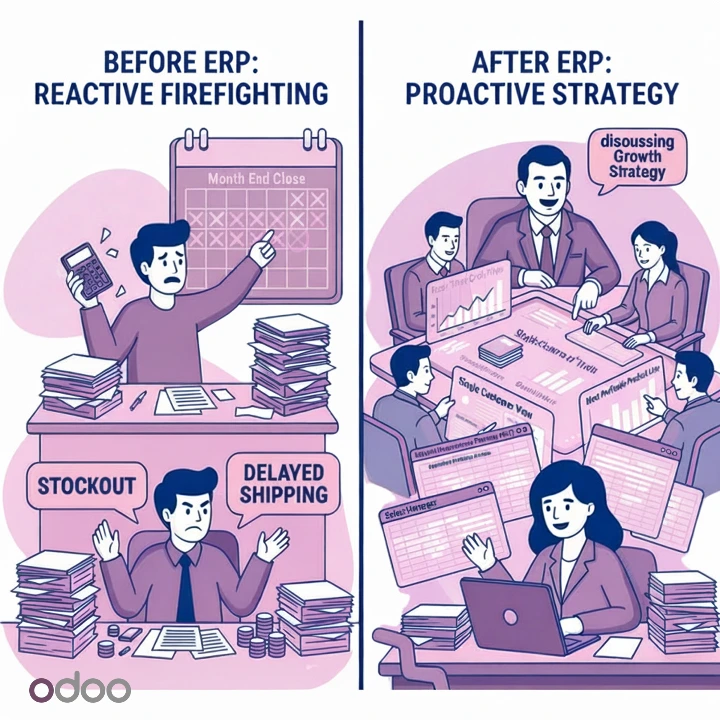
How ERP Affects Your Team

Finance Manager

Operations Manager

Sales Manager

Business Owner
This shift from reactive firefighting to proactive strategy is the single biggest return on investment an ERP delivers.
A Real-World Example: From "Patchwork" to Integrated Business
Tayarlo Sdn Bhd, a Klang Valley tyre wholesaler, faced constant "system hangs" and fragmented data. By implementing Odoo ERP, they replaced their "Patchwork" setup with:
Instant Dashboards: No more waiting hours for sales reports.
Unified Tracking: Real-time visibility across Michelin and multi-brand stock.
Automated Comms: WhatsApp/Email statements sent directly to dealers.
Tayarlo didn't wait for the 2027 deadline, they used 2025 and 2026 to build a competitive advantage.
Why Odoo is the Top ERP Software for Malaysian SMEs
01
Native LHDN & SST Integration
02
A Global Framework for MFRS Standards
Odoo is built on IFRS (International Financial Reporting Standards) principles, which provides the essential foundation for MFRS compliance in Malaysia. It isn't a "black box" that promises compliance, it is a professional-grade tool that empowers your finance team to maintain audit-ready, internationally recognized books.
03
Modular and Scalable Architecture
Choose a system that allows you to start small, perhaps with just inventory and accounting and seamlessly expand into sales, operations, and marketing as you grow. In 2026, you shouldn't be forced to pay for a "Manufacturing" suite if you only run a trading firm. The ideal platform lets you add modules without switching systems or facing punitive cost increases.
Odoo’s modularity is its greatest strength. You can start by solving your most urgent pain points such as inventory and accounting to meet the 2027 e-invoicing bridge. As your business matures, you can "turn on" extra modules like CRM or eCommerce without the pain of a "rip-and-replace" implementation.
04
The Flexibility of a Global Partner Network
Because Odoo is an open-ecosystem platform, it is supported by a robust local partner network in Malaysia. These experts don't just install software, they customize the global engine to fit your specific Malaysian business workflows ensuring you remain agile regardless of how the regulatory wind blows.
2026 Is Your Preparation Year, Use It Wisely
"The future of Malaysian business is integrated, or it is obsolete."
An ERP solution in Malaysia is no longer just about buying software. It is about investing in your company’s ability to compete in a digital economy where speed, accuracy, and real-time visibility separate the leaders from the followers.
The question is no longer "Should we consider an ERP?" The question is "Is your current system ready for 2027, or is it holding you back?"
Don't wait for the compliance storm to arrive. Start your evaluation with Odoo today. Your future self and your team will thank you.