Customer Success Story
Company name: Euroservis SRL
Country: Italy
City: Trieste (with offices in Udine and Milan)
Industry: Consulting, Public Funding & Grants, European Project Design
Company size: <50 employees
Odoo users: >40
Apps implemented: Projects, Timesheets, Contacts, CRM, Sales, Subscriptions, Accounting, Documents, Knowledge, Website, Email Marketing, Social Marketing, Events, Surveys, Maintenance, Employees, Attendances, Recruitment, Time Off + 2 custom modules
Hosting type: SaaS
Implementation methodology: Odoo Direct
Customer Success Manager (CSTD): Andrea Ricchiuti
Euroservis: twenty years supporting businesses
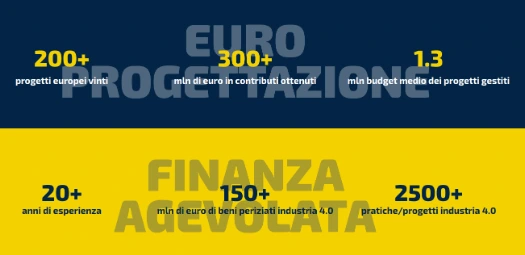
Founded in 2004 in Trieste, Euroservis is now a leading company in Italy specializing in European project design, public funding, and Transition 5.0 initiatives.
With offices in Udine and Milan as well, the group supports companies, public entities, foundations, and associations in accessing European and national funding, turning complex opportunities into tangible competitive advantages.
At the core of Euroservis’ work are complex projects, tight deadlines, and continuous collaboration between the sales team, operations, and administration.
For a consulting firm of this kind, managing dozens of active projects simultaneously without an integrated ERP system means a high risk of errors, delays, and unreliable reporting.
The challenge: disconnected data, unreliable reporting, and time-consuming activities
Let’s fast forward to 2023, when Euroservis managed its operations using a combination of disconnected tools: iDempiere for production-related activities, Excel spreadsheets for sales and administration, and an external platform for newsletters.
Each system worked individually—but none communicated with the others.
The result was fragmented data, time-consuming manual reporting, and information flows between departments that depended too heavily on people and too little on systems.
It was time for a change.
The most frequent issues
Inaccurate reporting: consolidating business data into reliable figures required lengthy manual work and was highly prone to errors.
Data entry errors: Excel files—especially when shared among multiple users—led to discrepancies and duplications.
Information silos: sales, operations, and administration teams worked on separate tools without a unified view of project status.
Disconnected newsletters: sending communications required exporting contact lists, manually verifying them, and re-importing them into the mailing platform.
Slow quotations: generating each project proposal took between 15 and 30 minutes, using Word templates individually modified and often altered by colleagues.
The difference between the perceived problem and the real problem
From the company’s perspective, the main perceived issue was project management. In reality, that was only a symptom.
The root cause of the challenges lays deeper: the company lacked an integrated ERP capable of connecting all business functions into a single cohesive system.
“Everyone was working hard, but all the data was disconnected. The great thing about Odoo is that from one module you can connect others, so you can easily obtain cross-module information.”
The choice: a modular, customizable, and cost-effective ERP
Euroservis’ initial objective was clear: map internal processes and find a digital solution capable of integrating them.
After analyzing internal workflows and comparing several alternatives—including Asana, Jira, and Monday—the company selected Odoo as its all-in-one ERP solution.
Key reasons behind Euroservis' decision
- Modularity: a single platform capable of covering all business areas—from project management to accounting, from CRM to marketing.
- Low-effort customization: thanks to the Studio app and training provided by experts, even non-technical users can build advanced reports and adapt workflows without relying on external developers.
- Complete standard foundation: the CRM → Sales → Projects workflow was already configured and operational, allowing Euroservis to start implementation immediately without waiting for a fully custom-built system.
- Cost efficiency: compared to fully custom ERP solutions, Odoo offers competitive functionality at a significantly lower cost, with the flexibility to adapt as needs evolve.
The implementation phase: starting from the biggest pain point
The Odoo implementation process at Euroservis began in September 2023 with a detailed mapping of internal workflows.
The chosen approach was bold: instead of starting with Sales, the company began with the Projects module—the area addressing the most critical business challenge.
At the same time, a major data migration effort was launched to import all active projects and existing contacts.
In December 2023, following the upgrade to Odoo version 17, the Sales module was configured. On January 1st, 2024, Euroservis officially went live on Odoo.
The evolution
Projects were customized using dynamic project categories, allowing fields and tabs to appear or disappear depending on the project type.
Automations based on project deadlines were introduced.
Newsletter management—previously handled through an external platform—was fully integrated.
HR modules were activated, including Recruitment, Attendances, and Time Off.
The Knowledge base was populated with operational guides, initiating a structured approach to documenting internal processes.
To manage change effectively, Euroservis relied on three key drivers:
- Mandatory fields (preventing users from moving forward without entering required data).
- Chatter notes (each project includes its own shared communication log).
- Monthly internal updates announcing newly implemented features.
Leadership played a crucial role: executives were the first sponsors of the project, turning change into a company-wide standard rather than an individual choice.
“Odoo is an information connector. The company’s core work doesn’t happen inside Odoo, but thanks to Odoo we spend the right amount of time on reporting and project updates. As a result, we free up time to focus on real work—the work that creates value.”
The outcomes: less time on manual processes, more energy for core activities
The benefits of adopting Odoo quickly became visible across multiple areas.
The most immediate improvement involved proposal generation: an activity that previously required between 15 and 30 minutes per quotation—using manually edited Word templates—can now be completed in just seconds. This has freed up valuable operational resources, allowing teams to focus on higher-value activities.
Projects can now be filtered by customer name, funding type, order number, sales representative, and many other criteria. Tasks that once relied on memory and manual searches now take only a few clicks.
Reporting has become extremely reliable, enabling a single source of truth for the entire management team.
An unexpected benefit emerged in the depth of cross-module reporting. Using Odoo Studio, Alberto Varin independently developed an advanced project profitability analysis system, combining data from Projects, Invoices, and Timesheets—a solution that would have required significantly higher time and costs with a custom ERP.
Finally, hybrid work—across teams distributed between Trieste, Udine, and Milan—has become much smoother. Chatter notes ensure that anyone taking over a project finds up-to-date context immediately, reducing alignment time and improving daily productivity.
Next steps: towards real-time financial visibility
Euroservis’ journey with Odoo has already reached a high level of functionality, yet it continues to evolve.
Upcoming developments include vendor billing integration—to capture company costs within the platform and enable full profitability analysis—and the Appointments module, which will automate client meeting scheduling.
Euroservis is also preparing to upgrade to Odoo version 19 to explore the AI-powered features integrated into the platform.
With these next steps, management will gain continuous access to up-to-date financial insights, allowing the company to remain focused on its core business—while Odoo takes care of the rest.
Eager to digitalize your consulting firm like Euroservis?
Find out how Odoo can help you integrate projects, reporting, and processes into a single platform—giving your team more time to focus on meaningful, value-generating work.